
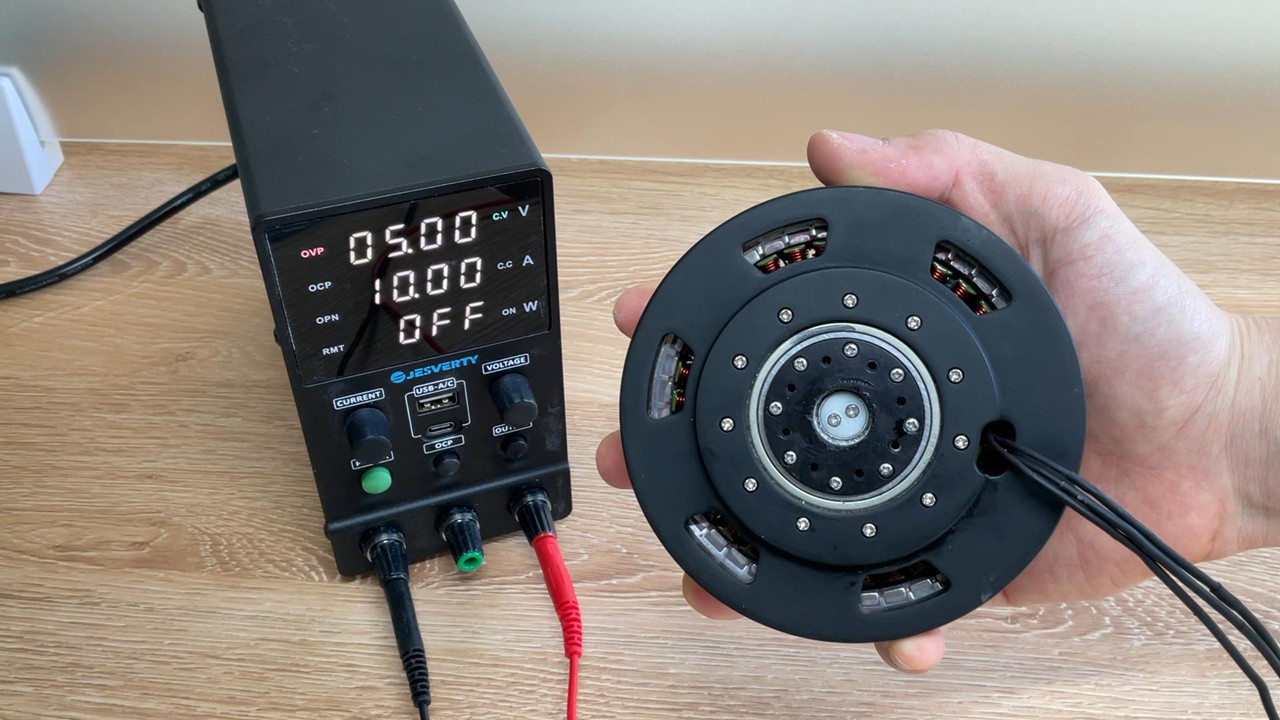
Internal Cycloidal Drive

About

While developing a quadruped robot to improve technical skills, the need for a high-torque and compact actuator became apparent. To address this challenge, I developed the "Internal Cycloidal Drive," which integrates an outrunner BLDC motor, a cycloidal reducer, and a driver into one unit.

In particular, the joints of a quadruped robot experience significant impact when landing, making the high rigidity and durability of the cycloidal mechanism an optimal choice. This design achieves an efficient and reliable actuator.

View on GitHub

How it works

Features of Cycloidal Gears

Cycloidal gears offer high torque and excellent impact resistance, but they also present challenges such as vibrations at high speeds and complex shape processing. To address these issues, I adopted a structure that combines two cycloidal discs in reverse phase, reducing vibrations caused by eccentric motion. Additionally, advanced 3D printing technology was utilized to ensure high-precision parts.

Assembly and Improvements

  • Assemble the cycloidal mechanism by mounting the rotor with N52 neodymium magnets and the stator with wound coils into the housing.
  • 11 outer ring pins were arranged to achieve a reduction ratio of 10:1.
  • Clearance adjustment of shafts and bearings was critical. In the prototype stage, contact issues between the rotor and stator arose but were resolved through redesign and precise adjustments.

Specs and Results

Specifications

  • Reduction Ratio: 10:1
  • Rotor Poles: 42 / Stator Slots: 36
  • Coil Wire Gauge: 22 AWG (Star Connection)
  • Designed for medium-speed and high-torque operation

Test Results

  • Tests with a low-cost ESC revealed that while self-starting was difficult due to slight contact between the rotor and stator, manual assistance enabled proper operation.
  • The performance of rotational speed reduction and torque amplification was demonstrated as expected.
  • Noise remains a challenge but is expected to improve with future redesigns.
  • The next step is to introduce a custom FOC-capable ESC to achieve more precise position, speed, and torque control.
< Projects Smart Servo Driver >